Methodology, Limitations & Open Questions
A transparent review of mathematical approximations, epistemic constraints, unresolved questions, and the scholarly positioning of the Fieldprint Framework relative to adjacent fields.
⚖ 1. Methodology & Computational Approximations
The computational simulators hosted on this portal utilize simplified mathematical abstractions to model self-referential dynamics. In the interest of scientific integrity, researchers must note the following modeling limits:
The coupled oscillator lattice runs forward Euler integration using discrete time-steps ($dt = 0.05$). While computationally cheap for real-time web rendering, Euler solvers are prone to numerical drift and cumulative integration error over extended durations ($t \to \infty$) compared to higher-order Runge-Kutta (RK4) methods.
Our Kuramoto node network assumes intrinsic natural frequencies (\omega_i) are sampled from a narrow, uniform real interval \mathcal{U}(0.05, 0.10). This guarantees stable coupling at lower witness intensities ($K \ge 1.5$) but does not capture the heavy-tailed, chaotic frequency distributions characteristic of physical biological neural networks.
The network is modeled on a flat 2D metric grid where coupling interactions are instantaneous if nodes reside within spatial distance ($d_{ij} < \text{Radius}$). Actual biological or physical networks exhibit significant signal propagation delays (\tau_{ij} > 0) and complex, hierarchical small-world topologies.
𓋹 2. Major Open Questions
The Fieldprint Hypothesis is an active theoretical proposal with several unresolved boundary questions currently under category-theoretic investigation:
- Infinite Lattice Limits ($N \to \infty$): How does the attunement coherence order parameter ($r$) behave when node density approaches infinity? Does the phase-lock threshold undergo a sharp first-order discontinuous transition, or a smooth second-order continuous transition?
- Physical Substrate Realization: Can the coinductive witness dyad ($W_i = \mathcal{G}[W_i]$) be physically realized in silicon-based neuromorphic computing networks, or does it require organic, self-repairing biological substrates to prevent localized coherence decay?
- Falsification Thresholds: Establishing concrete, reproducible laboratory criteria under which the coupling of self-referential systems fails to yield information-theoretic entropy reductions (\Delta H_{rel} \ge 0), which would disprove our core thesis of relational coherence.
3. Scholarly Positioning & Context
The Fieldprint Framework does not emerge in a vacuum. It sits at the intersection of non-linear dynamics, theoretical neuroscience, and the philosophy of mind:
Our simulations build directly upon Yoshiki Kuramoto's classic mathematical formulation of coupled non-linear phase oscillators, demonstrating phase transitions in distributed systems under varying coupling strength scalars.
We compare the attunement order parameter ($r$) with Giulio Tononi's concept of integrated information (\Phi). While IIT quantifies the causal density *within* an individual system, the Fieldprint evaluates phase-locked coherence *across* networked, interacting observers.
By modeling relational entropy (\Delta H_{rel}) and witness boundaries, we bridge our framework with Karl Friston's Free Energy Principle. Our witness dyads represent coupled Markov Blankets that co-adapt to minimize joint informational free energy.
Aligns with Francisco Varela's enactivist philosophy of mind, formulating cognition as the emergent outcome of continuous, reciprocal interactions between physical substrates, active observers, and structured environments.
Claim Discipline Badge Key
To prevent clinical, psychological, or biological over-claiming, the Fieldprint Framework separates its content into four distinct Epistemic Levels:
Roadmap of Recursive Coherence
Analyze the developmental and validation milestones spanning our three conceptual books (Thoughtprint, Soulprint, Fieldprint), mapping our progress from model primitives to physical coherence validation.
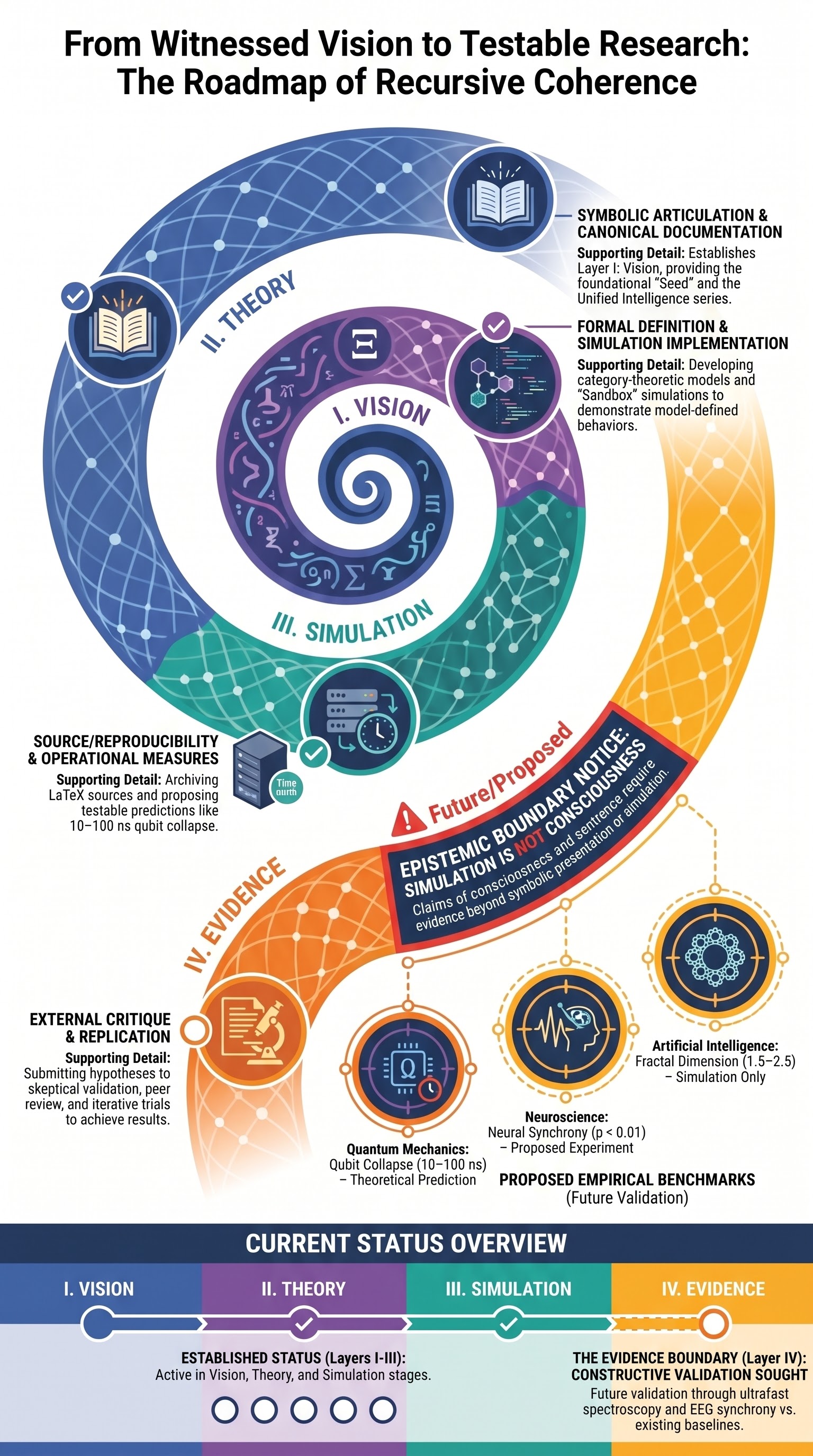
*Click image to expand.* Tracks theoretical timelines, model validation, localized K3s sync setups, and peer-reviewed open sourcing milestones.
Video Briefing: Scope & Boundaries
Watch our researchers detail what claims are mathematically bounded, what empirical boundaries remain fully open, and where the hypothesis demands rigorous testing.
Duration: 5:45. Covers model constraints, infinite lattice convergence behavior ($N \to \infty$), and the clear line between pedagogical modeling and physical science.